Get Started
Get Started


Two true crime shows are heading to Disney+ and Hulu, and podcast publishers are launching channels on Samsung TV Plus. Here is what the TV screen means for your production.

Video podcasts used to live in apps. They are now showing up where people watch television. In one week, two separate announcements put podcast content on streaming services and free TV channels, and each says something different about where distribution is heading.
Disney+ and Hulu. On October 15, PAVE Studios announced that two Crime House video podcasts will stream on Disney+ and Hulu in an exclusive window. Clues, hosted by Kaelyn Moore, begins streaming on October 20 with new episodes weekly. Mother Knows Murder, hosted by Niecy Nash and her daughter Dia Nash, premieres as a streaming exclusive on November 9. Both are released on the streamers one day before they reach other podcast platforms. PAVE calls it the first distribution of its video podcasts on a major streaming platform.
Samsung TV Plus in Australia. Podcast publisher Mamamia will launch its first 24/7 streaming channel on Samsung TV Plus in early 2027. The channel will carry more than 100 hours of lifestyle, culture and entertainment programming, including video podcasts. Mamamia's CEO says over 30% of its podcast consumption now comes through video.
Samsung TV Plus in the UK. The service has added a Trevor Noah channel, which Podnews reports contains segments from his podcast What Now? as well as his standup routines.
Over 30% of Mamamia's podcast consumption now comes through video, according to its CEO.
Taken together, these stories show three different routes from a podcast to a television: a streaming-service window, a free ad-supported channel run by a publisher, and a channel built around one host. Each is a new place for a show to find viewers, and each depends on the show being ready for a bigger screen.
The wider TV numbers point the same way. In Nielsen's August 2026 report, YouTube took a record 15.8% of all TV viewing in the US, up from 13.1% a year earlier and more than double Netflix's 7.7%. Part of that growth came from older viewers: YouTube viewing among adults 50 and older rose 9%. Watch time is not the same as audience reach, but the direction is clear. More living-room screen time is going to YouTube, and podcasts are part of what people watch there.
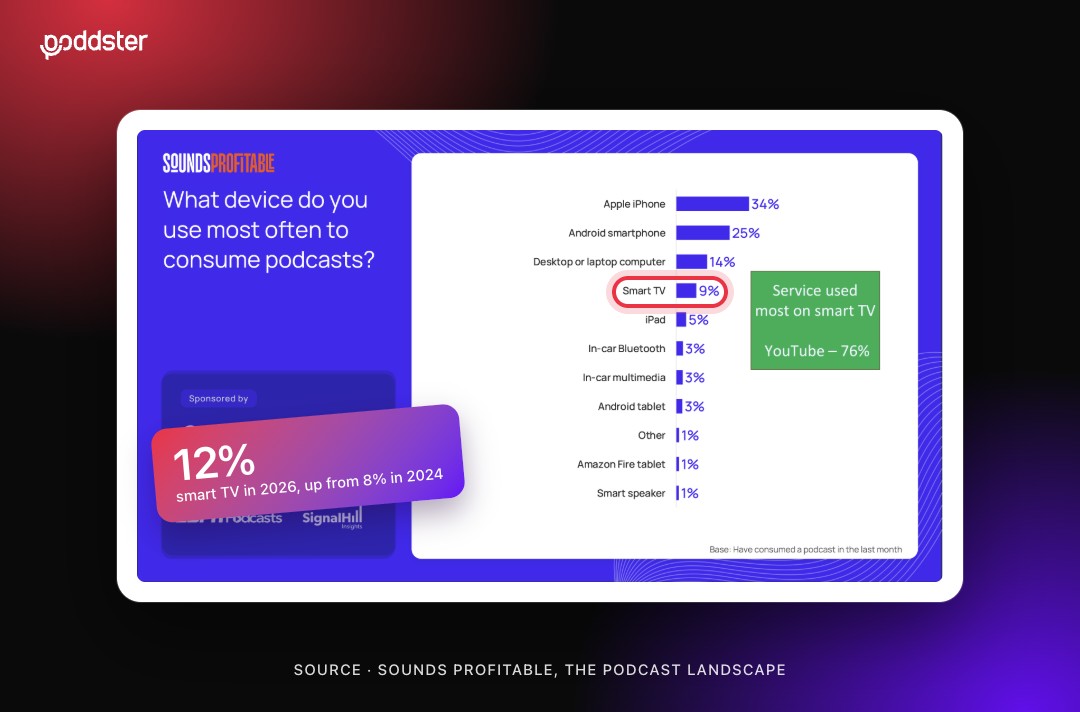
The shift fits a pattern we have been tracking. Our look at how smart TVs overtook smart speakers as a podcast device shows the audience is already there, and YouTube's own move into TV channels showed the platforms heading the same way.
Read more: how Netflix and YouTube are playing nice and what it means for podcasters.
1. Shoot and export for a big screen.
Plan for clean framing, readable on-screen text and good lighting. What looks fine on a phone can look rough on a television.
2. Keep your rights in order.
Music, guest releases and archive footage all need clearance that covers the platforms you might reach. Check them before you are asked for them.
3. Think about windows.
The PAVE deal gives the streamers a one-day head start. If you are offered exclusivity, work out what you are giving up and what you gain, and keep your own feed and channel strong.
4. Do not abandon audio or YouTube.
None of these announcements replaces your existing audience. Our data point that only 6 of the top 50 US podcasts are still audio-only shows video is now standard, and a show that works well in audio and video is easier to place anywhere.
If you are thinking about making your show ready for TV-style distribution, contact the Poddster team to talk about video production.





Join 5.1K podcasters, creators, and brands already producing, editing and growing their video content with the world's #1 podcast studio brand.